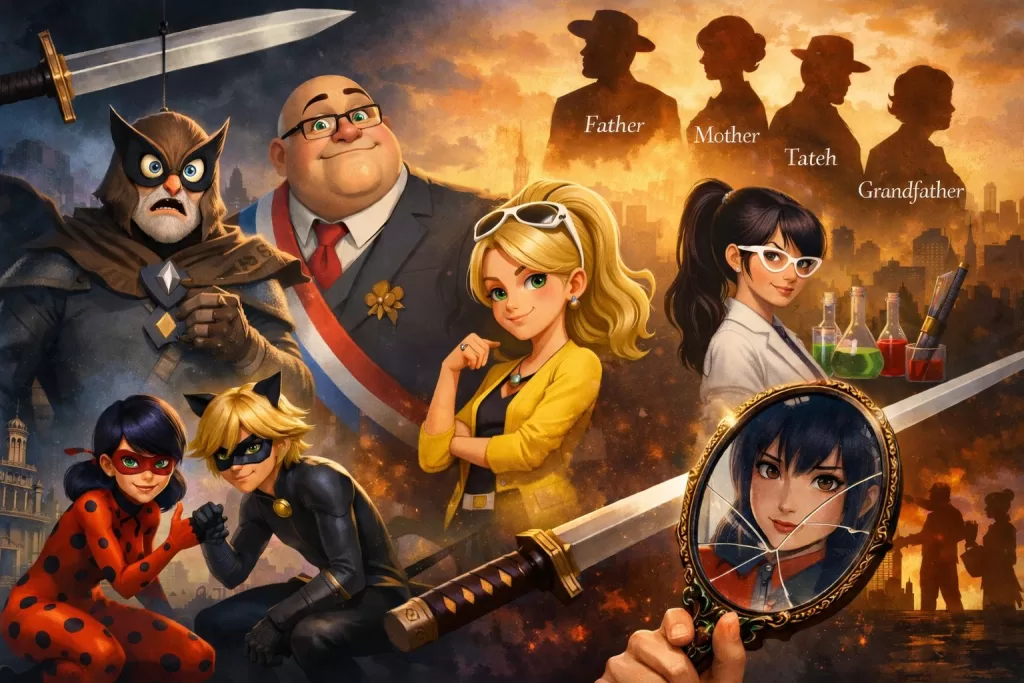
 Welcome to our first post bringing in a new literary work (my dear readers will have to make it a good 2/3 through this post to know which literary work I’m introducing).
If you happen to be one of the people visiting me after Awesome Con (I was pretty proud of that little viral promotion ploy… but I digress), you saw my note about “The Names.” If you read The Author’s manifesto on Not a Kids’ Show, you saw me allude to this. Now, it’s finally time to write that actual content.
The names in Miraculous are not designed to be just names. In fact, I would argue that the personal identification of the character is almost secondary. Here are some of the examples, both what I included in the manifesto and others that come to mind.
The Author feels it necessary to provide one caveat before diving into the specific examples. A literary principle exists called intentional fallacy. If you want to learn it in detail, read some texts on academic literary criticism. For the sake of our discussion, it boils down to, within reason, whether or not the actual author intended a meaning, that meaning is valid if it is present in a rational reading of the text. While I cannot confidently assert that Astruc and the writers intended all of these—though I maintain some are too clear to try to question that with a straight face—I can confidently assert that these meanings are consonant with the text in a deep reading.
Miraculous Names
Mr. Damocles
Lives under the constant threat of the sword falling on his head if he crosses Chloe Bourgeois.
I always lead with Damocles for this topic because he’s the one who first got my attention. I admit that I thought I misheard the first couple times. There was no way a “kids’ show” include a reference to the sword of Damocles—but they did. And this is one that makes me say it is incredible that this would be accidental. Damocles is not the kind of name one picks out of the air for fun.
Confession from The Author: I can’t hear his name without thinking of the Rocky Horror Picture Show song – “The sword of Damocles is hanging over my head…” (But that’s not the literary work, just a fun aside).
In any case, it is notable that the sword is, ostensibly, controlled by the mayor, but time and again, it is clear that Chloe is the one who controls both the sword and the threat. Until the very end of season 5, she maintains a similar sword over her father until he finally takes the role of a parent seriously.
Mayor Bourgeois (and family)
The bourgeoisie with a sash.
Again, I refuse to even entertain a notion that this is an accidental or incidental name choice. The Author’s claim, there, is further supported by the simple fact that the name has been chosen for a story set in Paris. Throughout the course of history, no culture has “owned” that term (in a negative sense) like the French since the late 18th century.
Mayor Andre Bourgeois and his entire family (save Zoey) are, since the mayor gave up his dream to produce films, near entirely driven by status and money. It could actually be said that Zoey provided the mayor finally with the example and desire to move past money to something else. But, that is fodder for another article. You’ll have to return.
Ms. Bustier
Even the ‘sweet’ teacher gets a name that’s… not subtle.
This one should make everyone who has ever been a teenager giggle every time. It’s also further evidence that the creators knew what they were doing and intentionally made the joke go just a little over the heads of the superficial target audience. Can one really claim that they just pulled the word “bustier” out of the air and gave it to the teacher who is pretty clearly drawn to be the sweet and cute one—who turns out to be a lesbian with the tail of season 5. The Author is unwilling to entertain such a claim.
Ms. Mendeleev
Yes. The periodic table teacher is named Mendeleev.
Ah, Ms. Mendeleev. Olga Mendeleev in case anyone questioned if she was meant to have a Slavic background—at least anyone of the intelligentsia since The Author does not at all expect a tween to even recognize the name. What subject could a high school (The Author notes that the age/school level of the kids seems inconsistent, so we will say ‘high school,’ as the show often does, but, even though the show indicates they are in 10th grade, it also asserts Marinette as being only 14 years old) teacher with the name Mendeleev, the developer of the periodic table, teach? Chemistry, of course! And it’s explicit that she does teach chemistry (confer Princess Fragrance and the dangers of flammable liquids in a chemistry lab).
Tsurugi-san
The Japanese Sword
Quite frankly, I’m going to spend less time on Tsurugi-san than others because she is fairly well discussed in the fandom. However, The Author intends to dig deeper into her name connected to that of her daughter—and maybe even touch on the price she paid to have Kagami—in the future, so she deserves mention.
The word tsurugi (剣) is Japanese for sword, but not just a sword, a very specific type of sword. The Author must concede he was previously unfamiliar. I know the katana, tachi, tantō, wakizashi, etc. but the tsurugi was new to me as I prepared this discussion. If you want to picture it, it is, in many ways, more similar in appearance to the traditional Mulan-style Chinese sword: straight and double-edged. It predates the swords we associate with the samurai by a few centuries at least.
The sword name fits well with the tsurugi clan who are said to be the descendants of an ancient Japanese samurai family. Indeed, the viewer’s first introduction to Kagami is an anonymous challenger to Adrien for the recognition as the best fencer.
The name fits beyond that, though. Tsurugi-san is rigid, sharp, unforgiving, and unrelenting, much as a Japanese sword, renowned for razor sharpness, is.
Kagami
The mirror.
After all this, The Author is concerned he is going on too long, so, this will have to be part 1 of N. But, if you would like a tease for the Tsurugi-Kagami discussion, just look up Japanese imperial regalia—you will thank The Author or forever hate him. The Author will dive in from Kagami onward in part two.
Names you can look forward to The Author batting around in the next part of this discussion:
- Kagami
- Felix
- Plagg
- Gabriel
- Chloe
- Adrien
- Nino
- Emilie and Amelie
The Literary Parallel
Before we leave behind this post, however, The Author is cognizant that he promised a literary connection. Granted, this is thematic and unlikely to be causal—or even an origin in any meaningful way—but it remains a parallel that I found interesting.
In 1975, E.L. Doctorow wrote a novel by the name of Ragtime. The Author has read the book, but he remains far more familiar with the musical adaptation, so that will be the source of this discussion far more.
In Ragtime, the main characters, for the most part, have titles, not names. I thought, the first time, I was missing something when I couldn’t figure out character names, but that was pretty clearly intentional from Doctorow. I suspect that someone who cares to look into it more could find actual discussion of that matter from him. However, The Author is writing about Miraculous, not Ragtime, so it is beyond the scope of this discussion to go into that in detail.
A few examples, though (as I said, I shall use the musical as my source material—because The Author has chosen to do so, and you cannot stop him). In the opening number, the characters largely introduce themselves, even speaking of themselves, by title rather than name, in the third person.
The first line of the show:
Edgar (one of the few named characters—though the audience finds out his name much much later:
In 1902 Father built a house at the crest of the Broadview Avenue hill in New Rochelle, New York, and it seemed for some years thereafter that all the family's days would be warm and fair.
Father:
Father was well-off. Very well off. His considerable income was derived from the manufacture of fireworks and bunting and other accoutrements of patriotism. Father was also something of an amateur explorer.
Mother
The house on the hill in New Rochelle was Mother's domain. She took pleasure in making it comfortable for the men of her family and often told herself how fortunate she was to be so protected and provided for by her husband.
Grandfather
Grandfather had been a professor of Greek and Latin. Now retired and living with his daughter and her family, he was thoroughly irritated by everything.
Note from The Author: While The Author has not taught at the university level, he considers Grandfather to be his spirit animal just from that description—especially the thoroughly irritated by everything.
Tateh
In Latvia, a man dreamed of a new life for his little girl. It would be a long journey, a terrible one. He would not lose her, as he had her mother. His name was Tateh. He never spoke of his wife. The little girl was all he had now. Together, they would escape.
Now, this one takes a little more explanation. Tateh is not, in fact, a name (well, it could be, but it primarily is not). Rather, it is the Yiddish word for ‘father.’ Obviously, Tateh could not “Father” since that name is already taken, so instead he carries the name from his original home in Eastern Europe.
The Author feels it necessary to keep you wanting more, so commentary on what he makes of that parallel shall come later, but feel free, in the comments, to jump in with your thoughts.
0 Comments