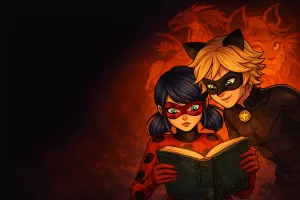
 I only recently (2025) discovered Miraculous. I don’t even recall why I said I’d watch a couple ironically. Unfortunately, I got hooked. I realized quickly that it is not the kids’ show it pretends to be. It’s definitely appropriate for kids, but these are not writers fulfilling the bare minimum necessary to entertain children—and it is unbelievable, utterly unbelievable, that the layers of meaning they included were accidental. And this was not the writers having fun in a single episode or even story arc. It is consistent and deepens throughout the series.
And I know blogs have passed out of fashion.
So have handwritten letters.
And fountain pens.
And bowler hats, too.
But I love them anyway.
The first proof: the character names
Mr. Damocles — He lives under the constant threat of the sword falling on his head if he crosses Chloe Bourgeois.
Mayor Bourgeois — He’s the bourgeoisie with a sash.
Ms. Mendeleev — Yes. The periodic table teacher is named Mendeleev.
Ms. Bustier — Even the ‘sweet’ teacher gets a name that’s… not subtle.
These jokes are all over the heads of kids—and probably most adults—but it is incredible that they would be incidental. And once you notice it, you can’t unsee it.
The deeper proof: the moral arc
On top of that, the show develops themes that are way beyond what little kids will get, all while flashing bright colors on the screen and having adolescent protagonists do silly things. I’ll give just one example in this little essay, then the rest of this little vanity project will provide more. The show examines the roots of evil—what it is to do evil acts—and, beyond that, whether redemption is possible. Gabriel Agreste doesn’t start his quest evil (before the narrative of the show), but he is crushed by the loss of his wife, and he decides to work to bend the universe to his will to get her back, the cost to anyone else be damned. If this were just a kids’ show, we would get a nice, “look, he turned and became good” moment, that nice little morality tale. Instead, he descends deeper and deeper until his most devoted ally rejects him as having gone too far and let his quest for love turn into a quest for vengeance.
In a kids’ show, he may have that last moment that everyone cheers as he realizes the error of his ways and is redeemed. It’s important that Gabriel Agreste is not actually redeemed. He just has one final act that is finally no longer evil, not enough for redemption, but enough to show depth. The show goes out of its way to indicate that he was not properly redeemed. So we, as audience, are left wrestling with the question, “Is one final good act worth it if it cannot redeem previous failure?” (Spoiler alert: real life is complicated, but yes—one good act still matters.)
Anyway, I think I made my point. The rest of this project will go through all of these and draw the connections I’ve noticed. I invite you to engage, argue, discuss. My image of this project is a group of friends over some nice stouts performing heavy exegesis on a “kids’ TV show”—that turns out to be so much more. My working assumption is that Miraculous has a grammar—of love, power, secrecy, and cost—and that grammar is consistent. It is filled to overflowing with themes that touch on literature, fine arts, philosophy, theology, ethics, and more besides. This site is my attempt to read it out loud.
0 Comments