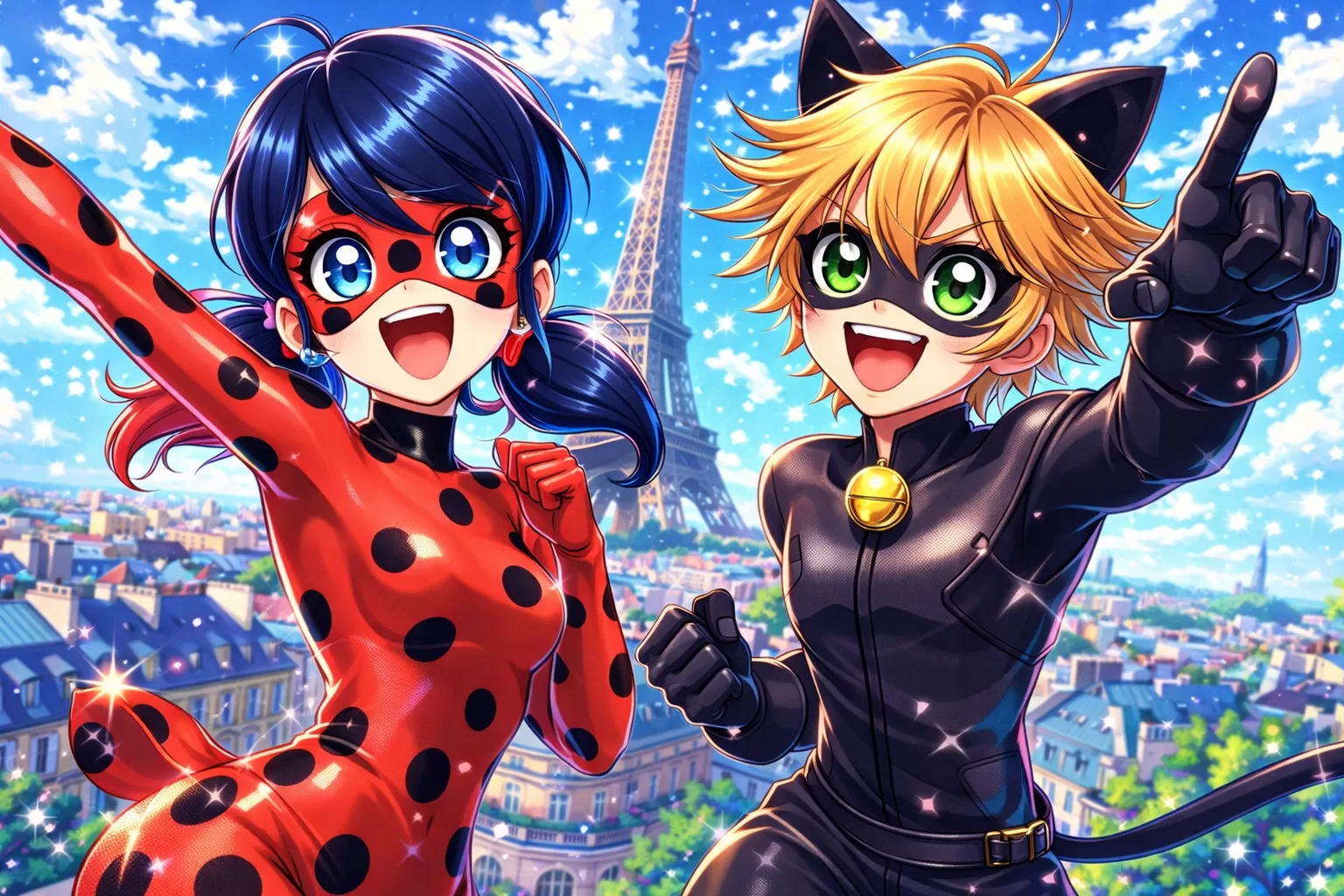
There is something unusual about Miraculous that The Author has frequently had trouble trying to explain, but this is the best thesis statement I've been able to come up with.
Miraculous Ladybug is a French Anime™.
What I don't mean
I realize anime, by definition, comes from Japan and fits in a certain framework and rule set. But I simply mean that Miraculous as a French anime (insofar as such a thing can be said to exist at all) is anime in the same way that Japanese Scotch is Scotch whisky or that California produces champagne. It provides a category and description, even though the most basic rule of the category is violated. So, yes, if you want to stop this conversation with "Anime is made in Japan." you're right. No one contests that. Otherwise, read on and let me know what you think.
What I do mean
Miraculous follows the rules of anime far more than it follows the rules of traditional Western children's animation or even adult animation. The visual style could be called anime adjacent.
First of all, the style follows many anime tropes. To the casual observer, the extent of "anime" just means giant eyes and a tiny mouth, but there are many more attributes of the category that, unless you are a big anime fan, are just taken for granted.
Realism vs. Stylized Expression
All of the characters have large expressive eyes with emotional microstates. As I found while trying to work with the wonderful world of generative AI to create the photo for this article, the shape of the eyes is certainly from the Western animation tradition, so that one certainly lands somewhere in between the two categories. The characters' faces show emotions quite specifically and simply—they follow specific rules to show what is being expressed at that moment, from Marinette screaming that it is the worst day ever to Manon giving the "baby doll eyes" to get what she wants out of Marinette (until Marinette learns to resist, obviously). To some extent, one could assert that this simplicity is just working within the limitations of the CGI engine, but it continues even into season 6 with the new Unreal 5 character models (we shall set aside if that is a good change or not - I think the teeth are at least capable of being more realistic, but I digress). This is taken to an extreme in the recent Tokyo episode with several even more explicit anime tropes—like Marinette eating too much and becoming almost an oversimplified fat little simplistic caricature of herself—but it's visible through the life of the show. Perhaps it's a better idea to broaden the eyes to a larger concept, though. With some exceptions, anime frequently does not interest itself in naturalism or realism in the characters—their eyes take up 90% of their faces, their hair is crazy-colored and defies gravity. Various features are exaggerated—for example, Su-Han's or Mr. Damocles' eyebrows. The goal is never to create a realistic portrayal of a person or even a cute little character style like we see in some Western animation—I'm thinking Rugrats—but instead to provide a canvas to externalize the character's emotions. So, we get big eyes, expressive faces, mouths that range from about 1 millimeter across to taking up most of a player's face. The characters do not have a Batmobile or invisible jet—or even the ability to fly—but instead run across roofs in Paris. Su-Han pushes this ad absurdum when he begins hopping toward Tibet to get help for Ladybug. The show even winks at itself (as it often does) by giving Cat Noir the line asking if he's going to hop all the way to Tibet.
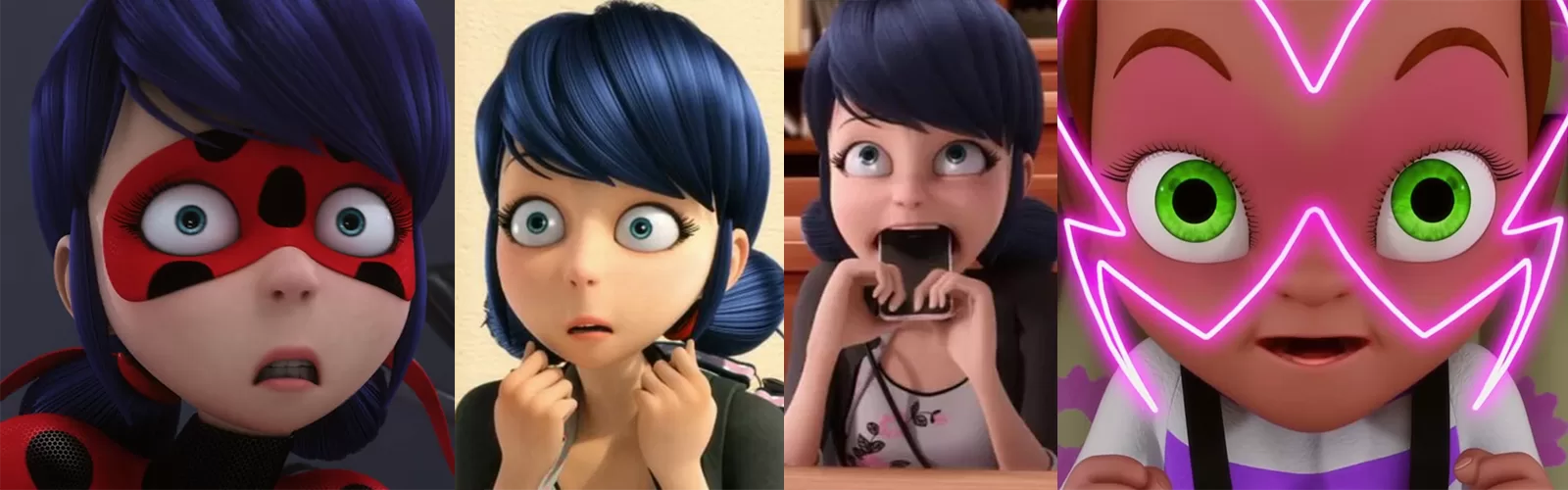
Facial expressions I argue are influenced by anime styles—just a few examples.
Transformations
The Miraculars' transformations into their superhero personae clearly pull from the anime playbook, re-dressing the character in the superhero suit. Think Sailor Moon—it's difficult not to see the parallel. I'll be coming back to this from other directions, too, so stay tuned. There's certainly a liturgical aspect (but you'll have to read my future writing to see it). Each character has a transformation style and sequence unique to that character—notably not unique to the Miraculous, but rather the person brings the personality. Even when the character doesn't understand, yet, as in Marinette's first time transforming wherein it seems to actually scare her, the transformation is an expression of the character's personality, not just a generic jump to superhero mode. I'll admit, I'm actually frustrated that, save once in the English language versions so far, neither Marinette nor Adrien have transformation sequences. I have notes to talk about that, too, but again, that means you have to come back when I write it. Anyway, the whole transformation sequence for each character is straight out of mahō shōjo (magical girl) tradition. It's more than a costume change—it is an almost ontological change from person to superhero. This differs immensely from Clark Kent jumping into a phone booth. There, he always has his powers, but just removes a disguise. Here, the characters when they are not in their role as heroes are just as important. It almost seems an insult to refer to them, as the show frequently does, as 'secret identities.'
Moral Architecture
Let's face it, Western children's animation (heck, even adult animation like Family Guy or The Simpsons, though, admittedly, there are exceptions) tends to be entirely episodic. The characters reset, and the lessons and cost of previous adventures are generally washed away. This is often supported by the clean endings that are provided in each episode. Miraculous, however, following more of the anime rules builds over the arc of serials, seasons, and even the series. Consider the increasing moral weight as Gabriel continues to decline into something akin to madness to the point that even Nathalie rejects his quest and fights against him. Such development, especially for a villain, is alien to most Western animation unless it is taking cues from anime. Here's a short pithy way to say where I'm going here: Miraculous is structurally serial. However, consequences accumulate, and secrets matter. That's far closer to anime logic than children's cartoon logic—at least the common cartoons.
Exaggerated Physique
Granted, Western animation does this also, but I consider it worth noting, still. While, in general, the characters follow a somewhat consistent sizing model when compared to one another, in that, they are generally realistic. However, there are several characters that stand out. For example, Adrien's bodyguard is already gorilla-sized, which makes it oddly appropriate when he is turned into a gorilla by akumatization. Mr. Damocles is shaped so top-heavy that his legs would almost certainly break beneath him. Master Fu is even smaller than a teenage girl (and 180-something years old).
Cinematography
It feels odd, even to The Author, to refer to animation as cinematography, but I lack a better word for it. As a rule, Western animation has much simpler camera angles and more static cameras. The camera is simply an observer of the scene. In Miraculous, as in anime and live cinema, the camera is a part of the composition. We see frequent broad camera sweeps, dramatic pans and zooms. I'm pretty sure I've even seen at least one dolly zoom. That's not common cartoon work. That's heavy filmmaking! Modern Western cartoons do use dramatic camera angles, especially now that computers have made it cheaper to do that, but they don't tend to include dramatic cinematic camera movements that not only observe, but participate in creating, the scene.
Emotional Centrality of Adolescence
This is important, though I admit it's not unique to Anime, it is far more central and reliable. Adolescence is not just a time of life that the story is set. It's not just antics of kids having adventures. Instead, it is formative. The children who hold the Miraculouses are forming into adults before our eyes. That's even called out in the show clearly as we see first Ladybug and Cat Noir, then the rest of the Miraculars, "become grown ups" and learn to use their powers without triggering the transform-back countdown. In this sense, this is not a kids show any more than Spring Awakening is a kids musical. We are watching characters struggle through growing up and finding what it means to be themselves—and then what that means when they accept the responsibility of a Miraculous.
Thematic Seriousness. Bright Colors.
I'm going to keep coming back to this, but, let's face it, like I said in Not A Kids’ Show (Even Though it Pretends to Be), the bright colors hide a very heavy underlying emotional arc for many of the characters ranging from Marinette to Gabriel to Mr. Damocles—pretty much almost every defined character. The show explores grief, moral burden, fractured or lost identity, the price of love—especially sacrificial love. That's anime coded, not Western kids' shows.
Character Archetypes
Over the decades, anime has developed many character archetypes that run across creations. It's somewhat startling how well they map to the characters in Miraculous. I was going to go through a whole list of those archetypes and demonstrate how they map into Miraculous, but I'm going to leave that for another post. Instead, let's just use a single example. Bishōnen is an anime/manga trope throughout the tradition. The word literally just means "beautiful boy." A Bishōnen is a young male character whose beauty is stylized, elegant, and slightly androgynous — often linked to emotional sensitivity and tragic depth. Can you really tell me that is not Adrien? Of course they aren't just copying, but I would be willing to lay a modest wager that the writers and animators have this tradition in mind as they create him.
Now What?
So, I think I've shown pretty well that there's too much anime adjacent coding in Miraculous for it to be incidental (I can't speak to the intentions of the creators, but I suspect it's not accidental, either). Instead, it seems clear that Miraculous is intentionally coded to use the grammar of anime. However, as I said at the outset, I don't want to imply a flat playing field—the show is a French creation animated in Korea, so it's not anime. Rather, Miraculous is French Anime™.
0 Comments